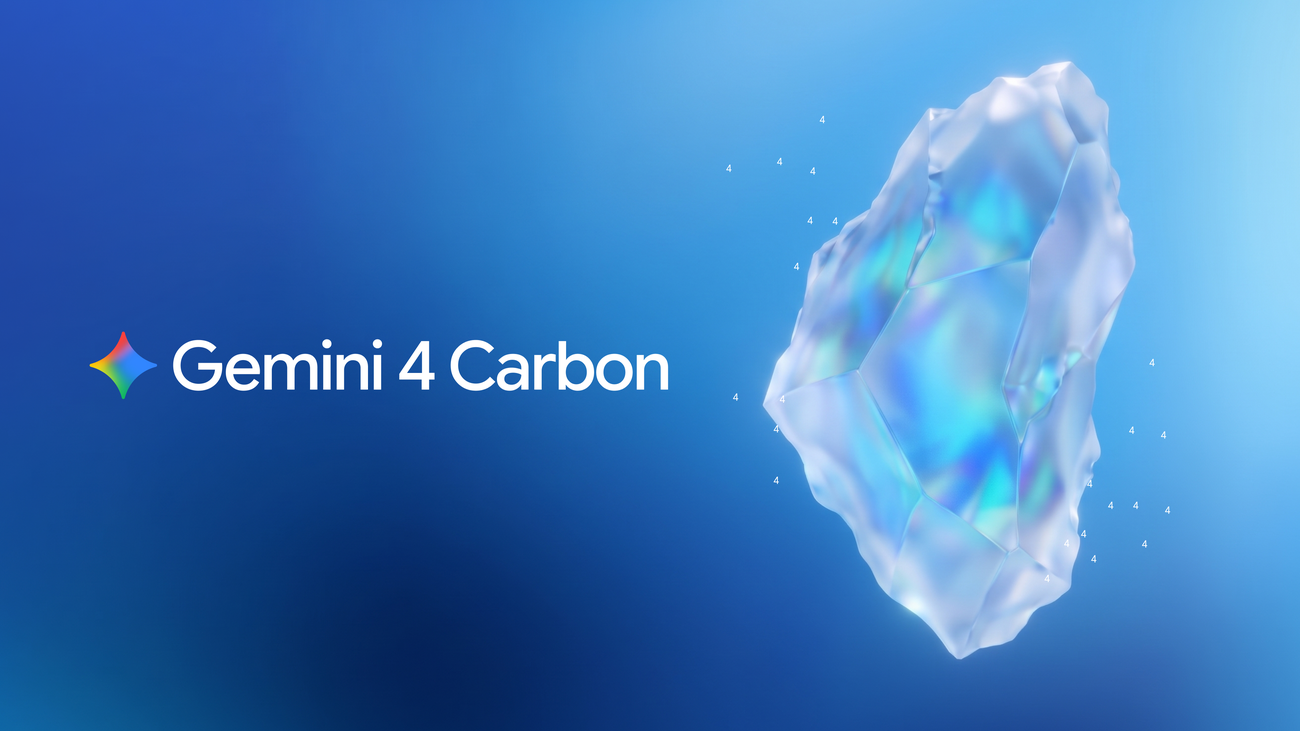
Google DeepMind released Gemini 4 Carbon on October 28, just two weeks after Gemini 4 Argon. I’m writing about it because Google has returned to the top of the independent benchmarks after a year, and because having the two best models at the same price in one lineup only makes sense for a short while.
What Carbon is and who gets it
Google’s strongest model. Google is selling it for cybersecurity and long-running tasks, which its teams describe as “runs lasting days.” It accepts text, images, video and speech as input, and has a context window of one million tokens.
For vetted users only, for now. First it goes to a subset of cybersecurity defenders, then to other partners in the Fairwind program. Google admits governments, critical infrastructure operators, large technology platforms and academic labs into the program, vets each one, and restricts use to defense and research. It has more than 650 partners. For developers, companies and regular users, Google promises Carbon “as soon as possible,” but gives no date. The model doesn’t even have a public name in the API yet.
Priced like Argon. The standard price is $4 per million input tokens and $20 per million output tokens, the same as Opus 5.5. A 50 percent introductory discount currently applies, and Google hasn’t announced when it ends.
Its place in Google’s family: Argon’s successor
| Model | AA Index | Cost per task | Availability |
|---|---|---|---|
| Gemini 4 Carbon (high) | 59 | $7.76 | Fairwind only |
| Gemini 4 Argon (high) | 50 | $7.68 | public |
| Gemini 3.8 Flash (high) | 31 | public |
The index is version 5.0 from Artificial Analysis; cost per task is at standard pricing.
Nine more points for the same money. Carbon and Argon cost the same per token, and a task on the index comes out at nearly the same cost. Once Carbon is available, Argon will lose most of its reasons to exist. Carbon is therefore more a second version of Argon than a new tier in the lineup (and the Argon and Carbon names have confused even commenters on Hacker News). Argon does keep one advantage: when it doesn’t know an answer, it makes one up in 4 percent of cases, versus 11 for Carbon.
The middle of the lineup is missing. Between Flash with 31 points and Argon with 50, Google has nothing. OpenAI sells GPT-6.1 Terra and Sol here, which score 51 and 55 points for roughly a dollar per task. If you need a cheap, smart agent, you won’t find it at Google yet.
Versus Opus and OpenAI
| Model | AA Index | Cost per task | Vals Index | Cost of the Vals test | Price per million tokens (input/output) |
|---|---|---|---|---|---|
| Gemini 4 Carbon (high) | 59 | $7.76 | 70.4% | $10.51 | 4/20 |
| Claude Opus 5.5 (max) | 58 | $10.04 | 70.2% | $28.12 | 4/20 |
| GPT-6 Astra (max) | 57 | $6.25 | 65.0% | $21.28 | 10/50 |
| GPT-6.1 Sol (max) | 55 | $1.27 | 63.9% | $3.61 | 2/10 |
Sources: Artificial Analysis (index 5.0, standard prices) and Vals AI. Both firms measured Carbon at the high level, while Artificial Analysis measured its competitors at the highest level, max.
First place by one point. Carbon leads the Artificial Analysis index, but the gap to Opus is within the margin of error. On the Vals Index, which measures work in finance, law, taxes and programming, Carbon is second behind Sonnet 5.5 and ahead of Opus. There too, the top three are within the margin of error.
Cheaper than Opus; versus Astra, it depends on the test. Carbon costs the same per token as Opus, but it outputs 29 percent fewer tokens. A task on the index therefore comes out roughly a quarter cheaper, and with the introductory discount, half of Opus’s cost. On Vals, the test costs a third as much. Astra is two and a half times more expensive per token, yet on the Artificial Analysis index a task still comes out a fifth cheaper than on Carbon. On Vals, by contrast, the test on Carbon costs half as much, and Carbon is five points better. And GPT-6.1 Sol scores four points lower on the index for a sixth of the price.
Best of all in knowledge. On the AA-Omniscience knowledge test it scores 54 points to Opus’s 48. It answers 58 percent of questions correctly, and when it doesn’t know an answer, it makes one up in 11 percent of cases. Opus and Astra make things up in half of cases.
Research, finance and law are its home turf. On Vals it ranks first in the finance index and in the legal research test (out of 87 models). Artificial Analysis also puts it first in scientific terminal tasks and in the hardest HLE-Diamond questions.
In programming it stays behind Opus. In Artificial Analysis’s coding agent index, Carbon scores 59 in the Antigravity CLI tool and ranks second, while Opus in Claude Code scores 62. In Code Arena, where people vote between web apps, it’s fourth (Opus first), and on Vals’s Terminal-Bench also fourth. For Google, which lagged in programming for a long time, it’s still a big step forward. Just be aware that nobody has measured it in any harness other than Antigravity yet.
It doesn’t lead in office work. On the AA-Briefcase test it has 1609 Elo points, Claude Sonnet 5.5 has 1812, and even Kimi K3.1 Pro and Muse Wonder rank higher.
Google’s table and cybersecurity
The table is fairly honest. Google compares itself with the current top models and also shows rows where it loses: in programming (FrontierSWE) to Astra and Opus, and in computer use (OSWorld) to Opus by six points. It leads in the Agents’ Last Exam professional-tasks test (77 percent, Astra 73, Opus 72) and by a wide margin in long context, though it measured that itself.
The cyber numbers are without safeguards, and one has a catch. SEC-bench Pro (finding vulnerabilities) 88 percent, ExploitGym (building exploits) 55 percent, vulnerability patching 71 percent. All the tests ran without safety safeguards, so the deployed model will behave differently. In ExploitGym, Carbon had a ten-hour limit and Opus a six-hour one. Carbon has no system card; Google points to the Argon report.
A closed launch is already the norm. OpenAI released GPT-6 Sol Daybreak only to vetted defenders, and Anthropic is doing the same with Mythos. A model that can find and exploit vulnerabilities goes first to the people who fix them. I understand that. But on Hacker News, frustration prevails that open-source developers, who fix bugs most often, aren’t allowed into the program.
Bottom line: what to take from this
Once Carbon is available, try it for research, finance and law. That’s where it leads the independent measurements, makes little up, and costs a fraction of Opus.
For programming, stay with Opus if you have it. Carbon is close, but behind Opus in every independent measurement.
If you’re building on Argon, prepare to swap. Design your application so the model can be switched with a single line. Carbon delivers nine more points for the same money and will most likely replace Argon soon.
Google has nothing for cheap agentic work yet. Take GPT-6.1 Sol or Terra.
For me, it’s the best model Google has released, and for the first time in a long while I trust it in programming too. But the leaderboard changes every two weeks. By the time Carbon reaches ordinary developers, Opus or Astra may have a successor (and Sundar Pichai himself promises “continued acceleration”).
Sources: Google’s announcement from October 28, 2026; measurements by Artificial Analysis (index version 5.0, Coding Agent Index, AA-Omniscience, AA-Briefcase); Vals AI; Arena leaderboards according to its post on X; VentureBeat; AccessAllGPT on the Fairwind program; reactions from Hacker News and X. Google’s table and the cybersecurity tests were measured by the vendor. Data valid as of October 29, 2026. The text was written with the assistance of Claude Opus 5.5, a competing model.