It is already clear that the technology of 2023 will be artificial intelligence, AI. And if you’ve read my book Myths and Hopes of the Digital World, you’ll have noticed that I consider processors to be a key technology for AI and the world in general. AI can’t do without processors, it’s just that the world is so strangely divided now. The big ruler of the processor world is the ARM family. Can that change? Can something take over the role of ARM processors like these processors did to Intel? Don’t worry, I’ll try to write some information about it that will interest you even if you don’t care about processors. Because it will be business, influence and politics.
Some mandated information. What are RISC-V processors? They are processors based on the open instruction set architecture (ISA). They were created in 2010 at the University of California, Berkeley, and are now controlled by RISC-V International, for which the original authors have relinquished all rights. The association is now run by its members, and the basic idea and driving force is “communism” — that is, sharing the architecture. This is despite the fact that you can buy commercially licensed RISC-V processor cores. The paradox? Not at all…
RISC-V processors are an open alternative to ARM processors. The open instruction set architecture (ISA) means the underlying, common designs for the various important parts of the processors, but these do not create sufficient opportunities for commercial differentiation. The design and maintenance of these parts takes a lot of time, and that’s why companies designing processors choose one of the existing platforms, nowadays mostly ARM — they have the technical chassis and also the assurance of broad software support, on top of that they stick their own thing to sell: the look, the behavior, the performance and of course the logo … 🙂 It is the openness of RISC-V that means the possibility to customize everything easily, to take advantage of the existing basics and to move in a large ecosystem. Simply put, RISC-V can be considered the Linux of the processor world.
Is there any chance of another processor family entering the processor world to replace ARM? Well, it is very difficult and lengthy; just like we said in 1995 about the Wintel platform — it was unthinkable.
Above all, RISC-V has one significant disadvantage that is not an option with ARM, and that is the essence of its openness. This is because individual RISC-V processors do not have to be compatible with each other, as designers can change virtually anything. Therefore, RISC-V International decided to ratify and freeze the ISA at the minimum that all RISC-V labeled processors must meet. In reality, however, there is no enforcement mechanism to prevent different implementations of ISA. Yes, leading RISC-V processor designers such as Andes, SiFive, and CodaSIP comply with the ratified ISA, just with more or less attention to the details that burn them. As a result, far from all code will be portable between processors from different manufacturers without modification. And who will do the modifications?
A few years ago, it would have been a stopgap. I wonder who would force Microsoft to recompile its Windows to the new RISC-V models? No one! Well, nobody’s forcing it anymore either. Much of the real software running is more dependent on the cloud and the internet, if the processor can handle it, it wins. This also means that the importance of the operating system has radically decreased, in fact you just need to port some suitable Linux distributions or even embedded systems that support internet connectivity and you’re done. However, many RISC-V processors are also used in the Internet of Things (IoT) or industry for all sorts of data collection — and you don’t really need Windows for anything there.
It’s true that there have been a few IoT operating system designs, but their usefulness has been small. They were (from an IoT perspective) heavyweight systems that supported too much unnecessarily. While sensors are only good for sending data via MQTT, for example, edge devices need to receive and lightly process data before moving it towards the centre or rather the cloud. Customization of single-purpose systems is taken for granted here.
This is where RISC-V processors are strong. They are efficient, variable and, above all, they now have a better pull commercially. In fact, ARM has been severely hamstrung: in the pampering arms of Softbank, it has lost the incentive to acquire new clients, as its licensing policy has put new wedges at a disadvantage. And for some old clients it became an unattractive, even potential competitor at the time of the contemplated acquisition by Nvidia. And so, after a long time, serious processor startups based on RISC-V began to emerge, mainly aimed at the world of IoT, industry and data processing. There, it was to be expected that customers would reach for an independent platform rather than Nvidia’s property, which competes with anyone in data processing. And the fact that now, almost two years later, the deal is being written off due to regulatory disapproval won’t change much. The damage has been done. And let’s leave aside the situation in China. The latter is trying to take a leading role in the processor field, and giving ARM trouble and having their own platform to influence would be good for China. It just might not be RISC-V at all, there are voices that China is creating its own ISA, as hard as that is. Just for automotive, data collection and IoT purposes.
I find it unlikely that big processor companies like Qualcomm or Marvell will make a mass switch from ARM to RISC-V. Just porting development and testing tools would be extremely expensive and time consuming. But it is certain that these companies will also create RISC-V processor families in their offerings, both for side projects and for customers who wish to avoid ARM.
There is a lot going on in the market with RISC-V. Late last year it was confirmed that Google had ported Android to RISC-V, and Apple has also started using the architecture for some additional features. By the end of 2022, more than ten billion RISC-V processor cores have been sold, which is not a small number (but it’s also not a lot).
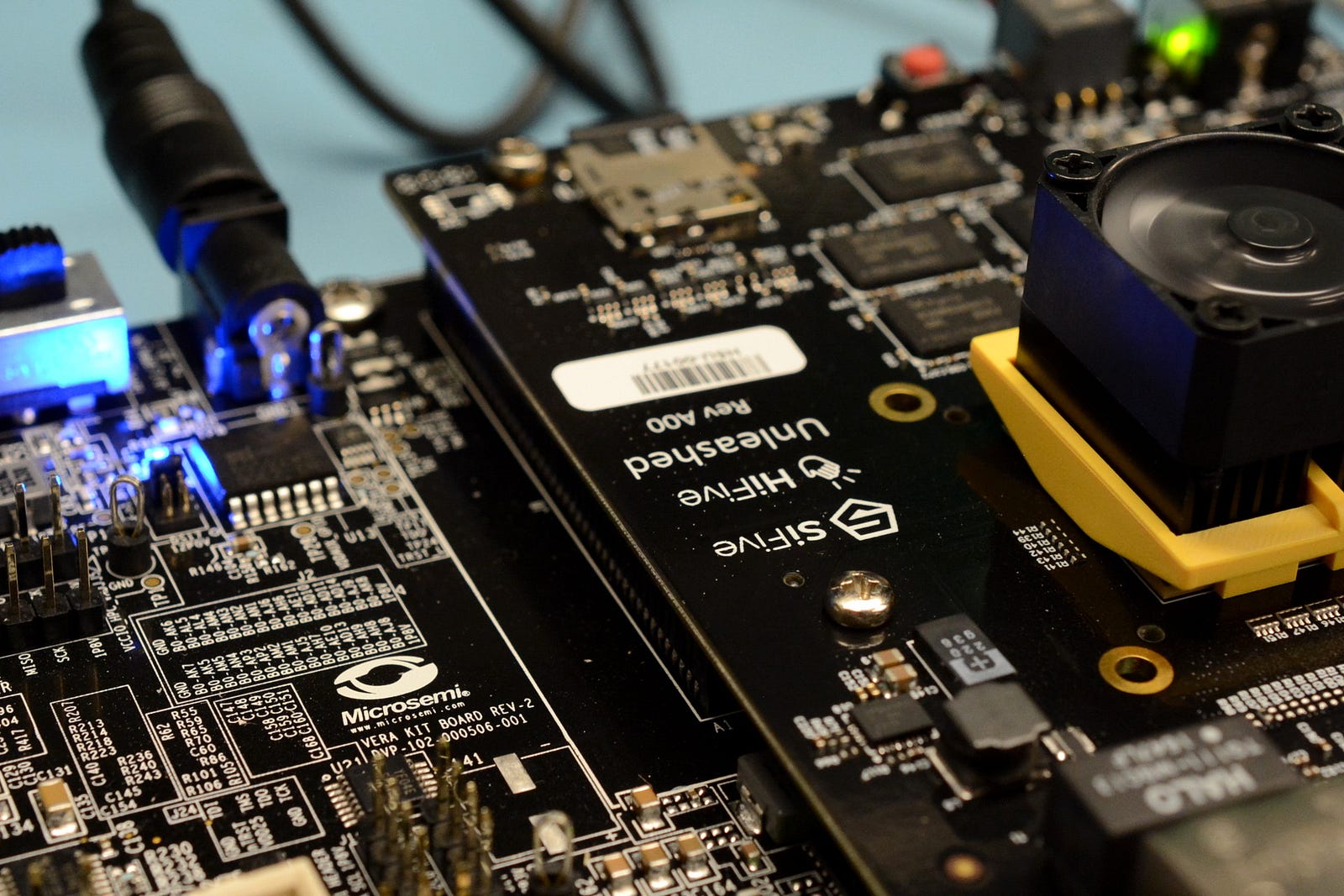
There are also serious attempts to get RISC-V processors into datacenters and make them into modern server processors. That’s still in a different league than making a processor that pushes collected data somewhere in the cloud. So far, the most serious contenders are Ventana Micro Systems, Tenstorrent, Rivos and Akeana. They’re not croppers, although you probably won’t know their names unless you’re a connoisseur: but Ventana, for example, has designed the first 64-bit ARM core. The Ventana Veyron VT1 is quite comparable to AMD Genoa in high configurations, for example, beating both Intel Ice Lake and Sapphire Rapids. Some of this can even be ordered for home experiments already, such as HiFive Unmatched boards, but these boards are based on cheap versions of RISC-V processors.
The developments in the processor field will be extremely interesting to watch. Incidentally, Codasip has its roots (and development centre) in the Czech Republic, and its boss Karel Masařík is also a member of the technical production steering committee of RISC-V International (article in E15).
Originally published on Medium on October 13, 2023.