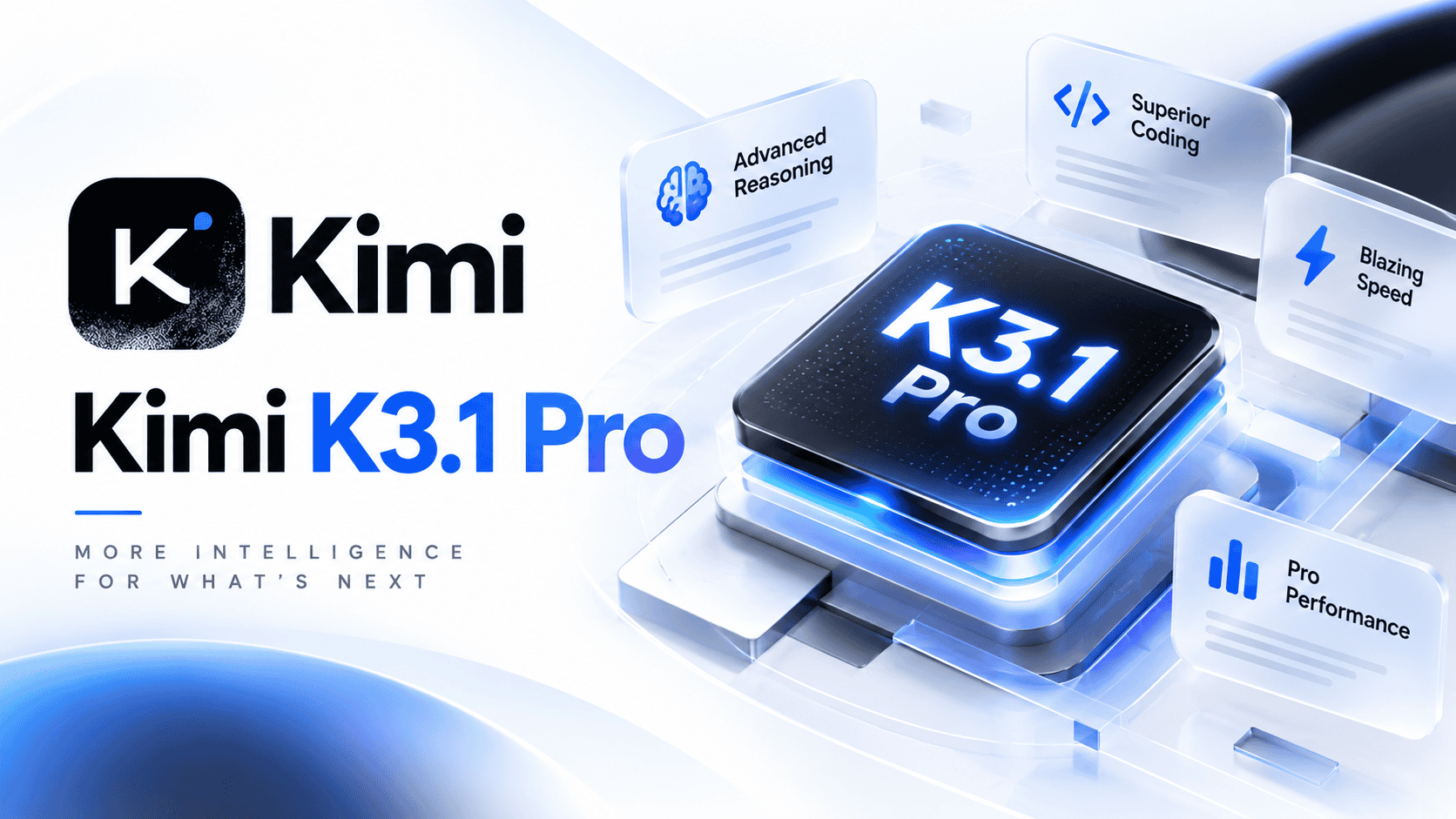
Beijing-based Moonshot AI, the company behind the Kimi assistant, released Kimi K3.1 Pro on October 23. I’m writing about it because once the weights are released, it will be the strongest open model, and by a wide margin. The previous record holder, Xiaomi’s MiMo-V2.6-Pro, scores 46 points on the Artificial Analysis index. Kimi scores 55. That’s a leap up a whole class!
What K3.1 Pro is
A retrained K3 with far more compute spent on post-training. The base stays the same as July’s Kimi K3: 2.8 trillion parameters, of which 104 billion are active for each token, a one-million-token context, and text and image input. Moonshot put significantly more compute into reinforcement learning (put simply, the model tries tasks and learns from the results) than it did for K3. It promises the weights by November 4 and hasn’t yet named a license.
Costs half of Opus per token. A million input tokens cost $2, a million output tokens $10. That’s a third less than K3 and half the price of Claude Opus 5.5.
The fast version costs the same as Opus. Kimi K3.1 Pro Highspeed is supposed to be two to three times faster, but it costs $4 per million input tokens and $20 per million output tokens. That’s exactly what Anthropic charges for Opus 5.5.
How it does in independent measurement
| Model | AA index | Cost per task | Weights |
|---|---|---|---|
| Claude Opus 5.5 (max) | 58 | $5.98 | no |
| Claude Sonnet 5.5 (max) | 56 | $5.46 | no |
| Muse Wonder Full (max) | 56 | subscription only | no |
| Kimi K3.1 Pro (max) | 55 | ~$2 | by Nov 4 |
| Gemini 4 Argon (high) | 53 | $1.99 | no |
| GPT-6 Astra (max) | 53 | $3.26 | no |
| GPT-6.1 Sol (max) | 52 | $0.72 | no |
| MiMo-V2.6-Pro | 46 | $0.13 | yes |
| DeepSeek V4.1 Flash 1017 (max) | 45 | $0.26 | yes |
The index is version 4.3 from Artificial Analysis.
Fourth in the world, 11 points above K3. Once the weights are released, the gap between open models and the closed frontier shrinks from 12 points to three.
Best ever at terminal work. On Terminal-Bench 4.0, where an agent solves programming tasks on the command line, Artificial Analysis measured 67 percent. That’s the highest result of any model it has measured, and even higher than what Moonshot itself reports (65.7). Kimi K3 scored 13 percent.
A tie with Opus on office work. On GDPval-AA it has 1846 Elo points, Opus 5.5 has 1866. In Code Arena, where people vote between two anonymous web apps, it’s eighth with 1692 points, roughly at the level of Opus 5.
The jump in knowledge is small. On Humanity’s Last Exam it improved from 47 to 52 percent. The hallucination rate (how often it makes up an answer it doesn’t know) fell from 53 to 44 percent according to Artificial Analysis. Moonshot, meanwhile, reports a two-thirds drop in its own test. Haiku 5.5 makes things up in 40 percent of cases.
Speed and real cost
The standard version is slow. According to OpenRouter it generates around 35 tokens per second, Highspeed around 56. On top of that, the model thinks and writes a lot: per index task it uses 14 percent more output tokens than K3.
In a data analysis test, GPT-6.1 Sol did better at a fifth of the cost. Plotly tests models on 43 data analysis tasks:
| Model | Result | Cost of the whole test |
|---|---|---|
| GPT-6.1 Sol | 43/43 | $2.61 |
| Grok 4.7 | 42/43 | $7.85 |
| Kimi K3.1 Pro | 42/43 | $13.47 |
| Kimi K3 | 35/43 | $5.01 |
Kimi is the best Chinese model Plotly has tested, and third out of 34. But one question took it 2.5 minutes on average, versus 43 seconds for its predecessor.
Cost per task depends on the effort level. Atomic Agent (on its own blog, so this isn’t an independent test) had Kimi and Opus 5.5 fix a small Python package. Both handled everything. At the default max level, Kimi emitted over 17 thousand output tokens, Opus around 4 thousand. So it cost roughly as much per task as Opus and took four times as long. At the low level it cost half as much and took twice as long.
It’s weaker with images. Ultralytics tried it on automatic labeling of objects in images. Gemini 4 Argon was more accurate, three times cheaper and five times faster. On 6.4 percent of requests, Kimi timed out.
So why does it come out at a third of Opus’s cost in the Artificial Analysis index? The index measures different tasks than the practical tests do, and Kimi’s cost per task varies strongly with the type of work and the effort level. Against Opus you’ll pay anywhere from a third to the same; against Sol or DeepSeek, significantly more.
Moonshot’s table
It compares itself with the current frontier. Moonshot puts Kimi next to Opus 5.5, GPT-6 Astra and Claude Fable 5.1. Last week, DeepSeek and MiniMax compared themselves with Opus 5 and GPT-5.6 Sol, that is, with the previous generation.
The footnotes are unusually detailed. For each test, Moonshot lists the harness and where it got its competitors’ numbers. For DeepSeek, it even showed its better older result instead of the worse one it measured itself.
One rule does help Kimi, though. In the OfficeQA Pro and Agents’ Last Exam tests, the model got a zero if it looked up the answer on the internet instead of solving the task. Moonshot writes that “some external models” did this. And it’s precisely in OfficeQA Pro that Kimi boasts the best result.
Cybersecurity: trimmed down, and still second in the world
In its announcement, Moonshot explains in detail that it deliberately removed cybersecurity data from training. In its own test, that dropped the model from 90.5 to 81 percent of tasks. According to the company, the open weights are not supposed to push the frontier of offensive capabilities.
On the Artificial Analysis Cyber Index, K3.1 Pro is nevertheless second among all models, with 64 percent. Ahead of it is only GPT-6 Sol in the Daybreak Blue version, which OpenAI gives only to vetted defenders. So after November 4, anyone will be able to download a model that is second in the world in cybersecurity. Moonshot explained its policy more honestly than the others (and that counts for something), but even after the trimming the model didn’t end up far behind the frontier.
Bottom line: what to take away from this
If you pay for Opus via the API for agentic coding and you’re not in a hurry, try Kimi K3.1 Pro at a lower effort level. In the only comparison available so far, on a small task, it delivered the same result at half the price, it just took longer. I have to say that I have an Allegro subscription for about $100, and when I used Kimi Code right after launch, I set something up wrong and practically within an hour I lost the whole five-hour limit, so I wasn’t very thrilled with the price. I used the fast version, which costs the same as Opus, and Opus seems better to me and also familiar…
If you need speed, stay with Opus. The Highspeed version costs the same per token, and in the first comparison Kimi emitted four times as many tokens on the same task.
If you’re looking for cheap agentic work, reach for DeepSeek V4.1 Flash 1017 or GPT-6.1 Sol. For a fraction of the price you get three to ten points less, which is usually enough for routine tasks.
If you pay a flat subscription for Claude Code or Codex, there’s no point in looking into Kimi.
If you want to run it yourself from the weights, wait for the license and the first measurements from providers. With K3, Vals found that the same model scored 76 percent on legal tasks through Moonshot, but only 61 through another provider.
For me, this is the most interesting open model of the year. In performance it has caught up with Opus almost completely, including terminal work, where open models have so far lost the most ground. It’s just slow, and whoever runs it at full throttle may save nothing compared to Opus.
Sources: Moonshot AI announcement of October 23, 2026, Artificial Analysis measurements (index version 4.3), Code Arena leaderboard, OpenRouter, tests by Plotly, Ultralytics and Atomic Agent, Vals AI on Kimi K3. Moonshot’s table was measured by the vendor. Data valid as of October 24, 2026. The text was written with the assistance of Claude Opus 5.5, that is, a competing model.