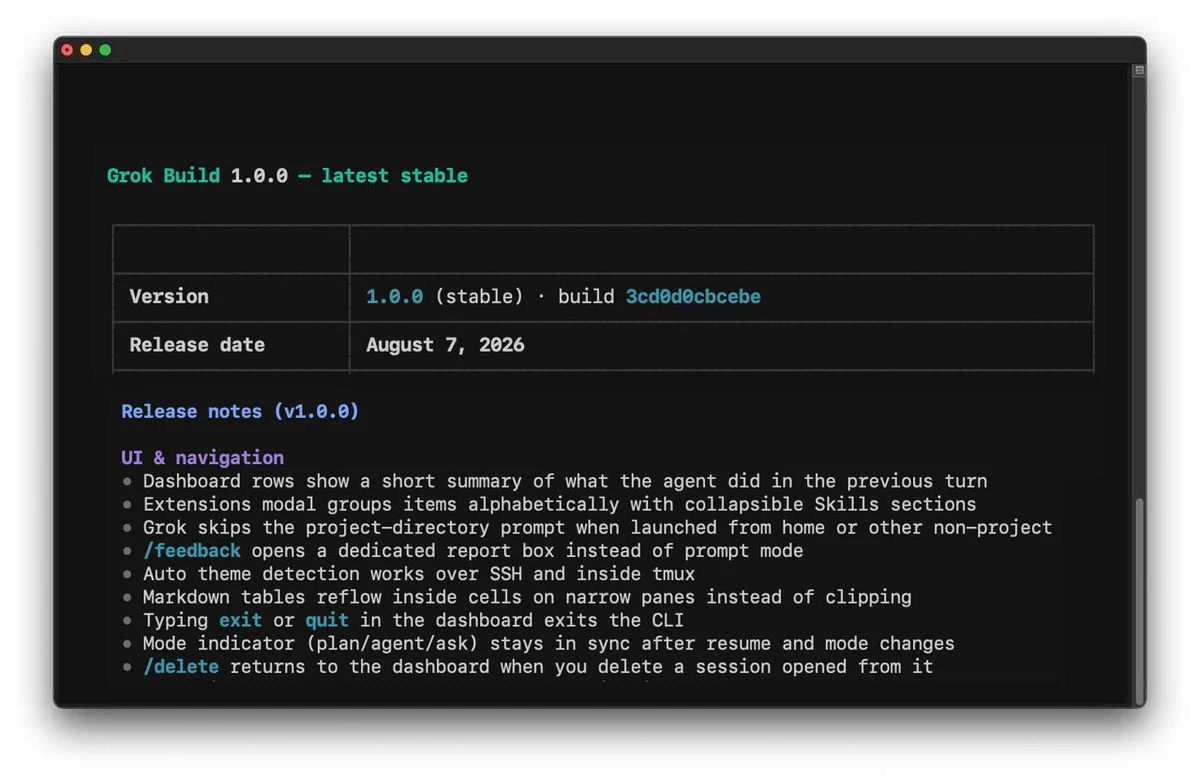
Long sessions produce long transcripts, and long transcripts bury the part you actually want to read. Background runs add a second problem: work happens out of sight and you want to manage it without spending a model turn. This week addresses both with /density, /timestamps and /workflow, and it makes grok worktree rm much more reluctant to delete anything you might still need.
Week 41 (October 5-11, 2026) brought versions 1.0.50 to 1.0.52: three releases with 273 changelog entries. Below are the main features, the smaller changes worth knowing, and a short checklist by type of user.
How much of the transcript do you want to see?
Density is now a setting. The new /density command and the matching Tool call density setting let you choose how much detail tool calls show in the transcript (v1.0.51). The modes and commands documentation describes what each level shows.
Expanded groups stay expanded. In v1.0.52, a tool call group you have expanded no longer collapses as new calls join it. If you watch a long run and keep one group open to follow it, that is the change you will notice first.
Thinking toggles faster. Ctrl+E expands or collapses thinking, and in v1.0.52 it does so faster in long transcripts.
Timestamps have three modes. The timestamps setting (v1.0.50) offers off, minimal and on. You find it in Settings, or you switch it with /timestamps. Together with density, you can tune the transcript toward a quiet log or a detailed record of when each step happened.
Display only. Both settings change what the TUI shows. What the agent does stays the same.
Changes for everyday work
Manage background workflows with /workflow. New /workflow commands let you list, stop and resume background workflow runs without sending anything to the model (v1.0.51). Those runs also appear in the tasks pane with a stop button. Details are in the background tasks documentation.
Sensitive details stay out of the model. The request form can now collect and fill sensitive details such as passwords or card numbers, and the values are never sent to the model (v1.0.51). For now, the changelog entry is the only description of how it works.
Web fetch approvals remember domains. Approval cards now include ‘always allow’ and ‘never allow’ options per domain, and your choice persists for the folder (v1.0.51). A related fix means always-approve mode now approves web requests without extra prompts. The permissions documentation covers the approval model.
Worktree removal asks more questions first. This is a breaking change in v1.0.50: without -f, grok worktree rm refuses to delete worktrees that are in use or contain unsaved changes, and exits with an error. Any script that called rm without -f and relied on it succeeding will now see that error. Two later releases tighten the behavior further:
- v1.0.51: if the unsaved-work check fails or times out, the worktree is kept.
- v1.0.52:
rmrefuses git repositories, .git folders and any directory grok did not create. - v1.0.52:
rmandgcleave alone a worktree that an open session is using.
See the worktrees documentation for the full behavior.
Goals behave better when you interrupt them. Pressing Ctrl+C on a goal now pauses it instead of letting it continue, and reopening a chat with an active goal continues it automatically (both v1.0.51). In headless mode, grok -p waits for background goals to finish and reports their outcome. --background-wait-timeout now also stops an active headless goal after the timeout and exits with an error, which gives CI jobs a clear failure signal. More in the headless scripting documentation.
Technical notes
Terminal and TUI.
- Shift+Enter, Ctrl+., Ctrl+/ and Ctrl+[ / ] now work inside tmux when extended-keys are enabled (v1.0.51).
- Tables rendered by grok have copy buttons that export clean TSV, CSV or Markdown suitable for spreadsheets (v1.0.50).
- Clicking the git branch in the header copies the full branch name (v1.0.50).
- Grok reports working, waiting, done or failed status to Rex via OSC 7501, so tabs in the Rex terminal show what each session is doing (v1.0.52).
Dashboard. It now shows which worktree each session belongs to, shows the -m model in the new-agent box, and lets you toggle worktree mode in the folder picker (v1.0.50).
Hooks and status lines.
- HTTP hooks to localhost now work, and bad hook URLs are reported at load time (v1.0.52).
- Bare hook commands such as
my-guardrun from PATH when not found next to the hook file (v1.0.51). - Project hooks in a repository subfolder load when you launch inside it (v1.0.52).
- Command status-line scripts see the current turn’s prompt ID and start time while the turn is active (v1.0.52).
Headless and CLI. grok accepts a prompt via piped stdin in headless mode, and --allowed-tools is now an alias for --allow (v1.0.50, v1.0.51).
Sessions, memory and SDK.
- Cancel and edit-resend on long sessions no longer unexpectedly revert workspace files (v1.0.51).
- Breaking: the memory options rollout and file_writes_enabled are removed, so memory is simply on or off (v1.0.51).
- Breaking: the
/sharecommand and related session sharing features are removed from the CLI and SDK (v1.0.51).
What to take away
If you live in the terminal. Try /density and /timestamps on a long session and settle on a combination you can read. Use Ctrl+E on a long transcript and see whether the faster toggle changes how you review thinking. If you run inside tmux, enable extended-keys and test the shortcuts listed above.
If you run parallel sessions. Try /workflow to list and stop background runs, and keep the tasks pane open to see them. Check how Ctrl+C now pauses a goal and how reopening the chat resumes it. In the dashboard, look at the worktree label per session. Before cleaning up, remember that rm and gc now skip a worktree an open session is using.
If you administer integrations and company deployments. Search your scripts for grok worktree rm without -f and for any use of /share, since both changes are breaking. Check your memory configuration for the removed rollout and file_writes_enabled options. Review hooks: localhost HTTP hooks work now and bad URLs surface at load time, so a previously silent misconfiguration may show up as an error. For headless jobs, set --background-wait-timeout deliberately, because an active goal that exceeds it is stopped and the run exits with an error.
Sources: the Grok Build changelog, versions 1.0.50 to 1.0.52 (released October 6-11, 2026), and the linked Grok Build documentation pages. Availability can change, so check the documentation if something behaves differently on your install.