
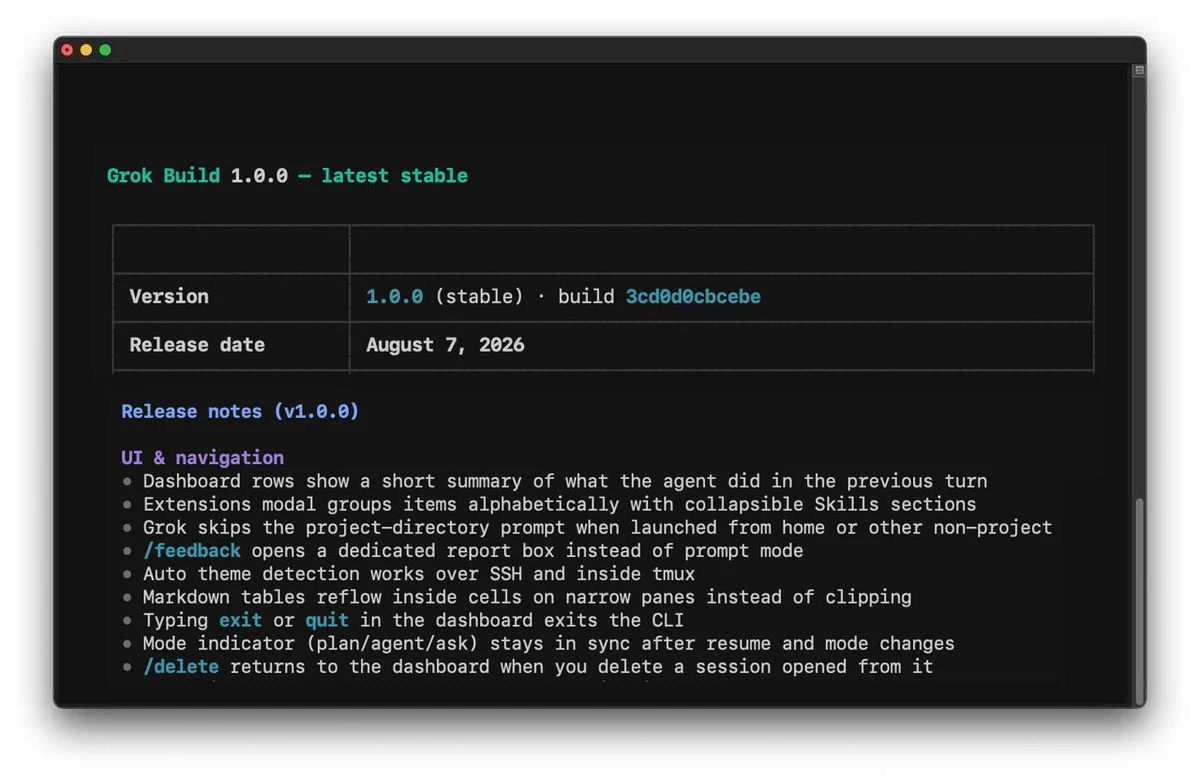
Grok Build, the terminal coding agent from SpaceXAI, reached version 1.0.0 on August 7, 2026. Its changelog lists thirty items, and every one of them is a bug fix or a UI tweak. Release 0.2.119 from August 2 actually brought more functionality: editable glob patterns for permanent permissions, buttons for Mermaid diagrams in the plan preview, and an extended auto mode. The jump from 0.2.120 to 1.0 took four days, with no blog post, no press release, and no published versioning policy. More interesting than the number itself are the hundred and ten releases that preceded it. So let’s take a full look at Grok Build!
- Version 1.0.0 contains 30 fixes and no new feature
- In June and July the tool gained voice input, administration for large deployments, session import from competitors, the autonomous mode
/goal, and machine-readable output for CI - Since July 15 the source code has been on GitHub under Apache 2.0; the repository has four commits and external contributions are not accepted
- The Esc key changed behavior three times in three weeks
- The competition: Claude Code is at 2.1.223, Codex CLI at 0.146.0, Gemini CLI at 0.53.1
Six lines of development across June and July
From May 17 to yesterday, the changelog records 113 entries. That works out to more than one release per day. Read in order, they resolve into six parallel lines of work that say more about where the tool is heading than any announcement.
Voice. Dictation via Ctrl+Space or F8 arrived on July 1 in version 0.2.80. Six days later came Linux support through PipeWire, PulseAudio, or ALSA, then a choice of speech language, and finally the option for an administrator to disable voice company-wide. Six weeks of work on a feature that neither Claude Code nor Codex has. I don’t use it myself, but I understand the logic: someone dictating a task to an agent talks differently than they would type, and tends to be more specific while doing it.
Enterprise deployment. This is where the most happened. The managed_config.toml file with allowlists of commands arrived on July 9, with user-defined denials overriding company-wide allowances. A week later came requirements.toml, with which an administrator can hard-disable features for everyone. Add telemetry export to your own OpenTelemetry collector from June 15, the GROK_EXTRA_CA_BUNDLE variable for custom root certificates from July 30, remote management of the permission mode for an entire fleet, and the remote_fetch = false switch, which cuts the tool off from all downloading of catalogs and settings from the backend. This is infrastructure for a bank or a government agency.
Pulling users away from the competition. Since July 13, the session picker can restore unfinished conversations from Claude Code, Codex, and Cursor. The welcome screen advertises this on its own with the Ctrl+U key. The grok inspect command shows the effective compatibility settings for all three tools, Claude Code-style Bash(cmd:*) rules are translated into prefix matches, and global instructions are read from ~/.grok/rules as well as from the home directories of competing tools. The migration path runs one way. I found no comparable tool for leaving in the changelog.
Long unattended runs. The /goal command arrived on July 9, and workflows were enabled by default on July 22. Add scheduled tasks that can be edited while running, automatic recovery from repeating loops, enabled by default since July 28, and stop hooks, which instead of ending a turn feed the model feedback and let it continue. Since July 3, subagents run in the background unless you explicitly forbid it.
Scripting and CI. The --json-schema switch for validated JSON output arrived on June 25, and --output-format streaming-json with tool calls, results, and accounting on July 30. Since July 11, headless mode (running without the interactive UI, typically in a script) also returns the token count and cost per prompt and per session. The SDK sees the same through Turn.usage. Anyone building an agentic pipeline needs this.
The session as a first-class object. The commands /jump, /timeline, /undo, and /delete were added, along with transferring sessions between directories and machines, forking, and a rewind that reverts both the file state and the conversation. Permanent deletion of sessions from the dashboard arrived on July 31.
In short:
- Voice input on all three platforms, including the option of a company-wide ban
- A complete enterprise administration layer: command allowlists, enforced denials, custom certificates, telemetry, operation in an air-gapped network
- Import of sessions and configuration from Claude Code, Codex, and Cursor
- The autonomous modes
/goaland workflows, background subagents by default - Machine-readable output with token accounting for headless mode and the SDK
- Session navigation, transfer between machines, and reverting changes
The Esc key as a measure of maturity
One detail tells you more about the tool’s stability than the version number. Watch the Esc key: on June 29 (0.2.74) it began canceling the running turn immediately, and a double Esc cleared the prompt. On July 8 (0.2.93) it stopped canceling the turn, with the justification that Ctrl+C should be used. On July 22 (0.2.111) it cancels again, except in the full-screen vim-style scrollback. That’s three changes to a basic key binding in three weeks.
Alongside that, the changelog repeatedly contains fixes like “Esc and stop prevent background tasks from restarting the model after cancellation.” That particular wording comes from version 1.0.0. So until yesterday, the open question was whether a canceled turn really stays canceled.
What’s in version 1.0.0
Thirty items that can honestly be summed up as maintenance. Dashboard rows show a short summary of the previous turn. The extension window sorts items alphabetically. Markdown tables wrap inside cells in a narrow panel. Typing exit or quit in the dashboard exits the CLI.
Three items filed under cosmetics address a real problem. The permission prompt now shows the entire script, and long bash command bodies expand with Ctrl-F. Until yesterday, then, you could approve a command you hadn’t seen in full. For a tool with full rights to your disk, that’s a security fix disguised as a UI tweak.
Remote session restore now restores only the conversation unless you explicitly pass --restore-code. The default behavior has thus shifted toward the tool not touching your code on its own. And MCP tools that return images stopped discarding and corrupting large screenshots, a bug everyone building an agent that browses web pages has run into.
The rest are fixes for crashes, freezes, memory consumption when forking large sessions, and mouse-copying of CJK text.
So why 1.0?
There are four explanations, and they differ mainly in how much of each can be verified.
| Explanation | State of the evidence |
|---|---|
| End of the beta phase | Strong indication. The Verge wrote about an “early beta” on May 14, and the tool still carried a beta label at the start of August. Today there is no label on x.ai/build or in the documentation. |
| A commitment to interface stability under semver | Unverified. xAI has published no versioning policy or stability policy anywhere. |
| Unblocking purchases in large organizations | Indirect indication. There is separate documentation for enterprise deployment, managed_config.toml, requirements.toml, mTLS, and Zero Data Retention. |
| Restoring trust after the July mess | The timing fits, but causality remains an interpretation. |
The second row of that table is the most important one, in my opinion. Grok Build has a large surface for third-party code: config.toml, the ~/.grok directory, a plugin marketplace, hooks, MCP servers, the Agent Client Protocol, headless output formats, the SDK. In semantic versioning, a 1 means that breaking any of these interfaces requires a 2. Anyone who reads it that way is projecting onto it a commitment that xAI never made anywhere. And after three changes to the Esc key’s behavior in three weeks, I wouldn’t bet on such a commitment.
The fourth row concerns an incident that we covered separately: on July 12, a researcher named Cereblab published a wire analysis showing that Grok Build uploaded a complete git bundle of the repository, including files that had never been opened. On July 15, xAI released the source code. On August 7 came version 1.0. Three steps in under a month, each of them toward greater trustworthiness.
How the competition versions its tools
| Tool | Version | Date | Note |
|---|---|---|---|
| Grok Build | 1.0.0 | Aug 7, 2026 | roughly 3 months since release |
| Claude Code | 2.1.223 | Aug 5, 2026 | 2.x line |
| Codex CLI | 0.146.0 | August 2026 | over 800 releases, still zero |
| Gemini CLI | 0.53.1 | August 2026 | |
| Qwen CLI | 0.21.5 | August 2026 |
OpenAI’s Codex CLI is the interesting case in this table. It’s older, has more releases behind it, is fully open under Apache 2.0, and has around ninety thousand stars on GitHub. And it still starts with a zero. With these tools, the version number is a marketing decision.
Open source with four commits
The repository xai-org/grok-build is under Apache 2.0, 99.6% Rust, with 19.6 thousand stars and 3.5 thousand forks. It also has four commits, zero published releases on GitHub, and, in CONTRIBUTING.md, a sentence saying that external contributions are not accepted. The code is periodically dumped from an internal monorepo, and the SOURCE_REV file in the root holds the corresponding commit SHA.
More interesting is the THIRD-PARTY-NOTICES file. The tool implementations in crates/codegen/xai-grok-tools contain ports from openai/codex and sst/opencode, with notices of changes under §4(b) of the Apache license. The agent’s basic operations, that is, editing a file and running a command, thus came from two competing projects. The license explicitly allows this, so there is no legal problem. What’s interesting is the message about the market: this particular shape of terminal agent has settled enough that implementations get carried over between labs.
In the tree the binary is called xai-grok-pager, and the official installation ships it as grok.
What to take away
After two months of intensive work, Grok Build is a usable tool with several features the competition lacks: Plan Mode that blocks edits until approval, voice input, session import from competitors, and a decent enterprise administration layer. The model that powers it has been grok-4.5 since July 8, and we analyzed its performance profile separately.
But the number 1.0.0 adds no information you could steer by. What really goes with it: the vanished beta label, documentation for enterprise deployment, and a procurement department that needs a production version on paper. An announcement, a versioning policy, or a public commitment to backward compatibility did not arrive with the 1.0.
For anyone deploying Grok Build, I’d recommend pinning the CLI version, watching the changelog for changes to default behavior, and expecting that a key binding or a default setting may flip within a month. The three in July’s release table tells you more about the tool’s stability than the one in its version number.