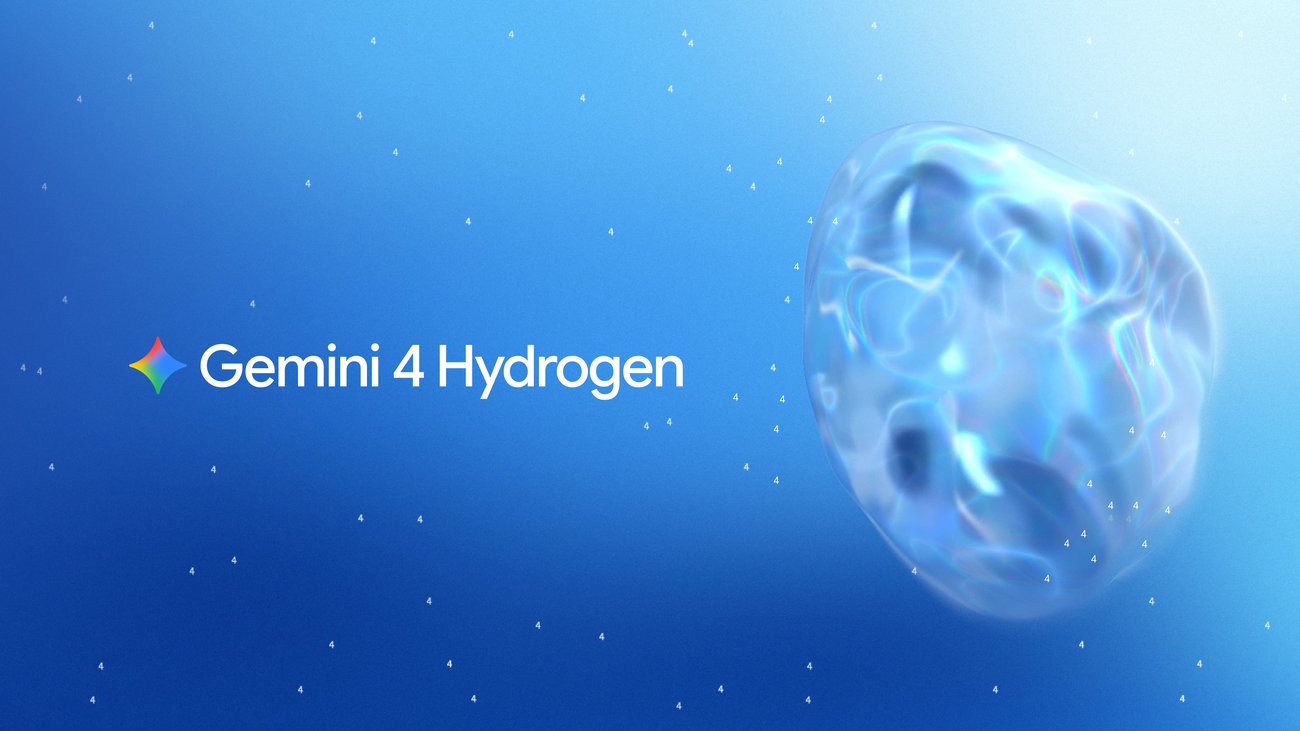
Google released Gemini 4 Hydrogen on November 12, which in its own words is “an everyday model for agentic work.” I’m writing about it because it fills the gap in Google’s middle tier that I criticized recently. All three big companies now have a complete lineup, and for the first time they can be compared side by side.
Meet Hydrogen
A fast executor. It can work on its own or under the big Carbon: Carbon plans, and Hydrogen launches the worker and review agents. It has four effort levels: low, medium, high (the default) and the new xhigh.
Pricing with no long-context surcharge. $1.50 per million input tokens and $7.50 per million output tokens, across the entire million-token context. Haiku and Terra both get more expensive beyond a certain length. Output can run up to a million tokens.
Available right now, everywhere. Gemini API, AI Studio, the Antigravity tool, the Gemini app (free via automatic model selection), Google Search and Sheets.
Three companies, four price tiers
| Tier | OpenAI | Anthropic | ||
|---|---|---|---|---|
| 1 · Flagship science, cyber, the hardest tasks | GPT-6 Astra: 10/50 · 57 | Fable 5.2: 8/40 · 65; Opus 5.5: 4/20 · 59 | Gemini 4 Carbon: 2/10, 4/20 from Dec 1 · 60 | |
| 2 · Workhorse agentic coding, long tasks | GPT-6.1 Sol: 2/10 · 55 | Sonnet 5.5: 2/10 · 55 | Gemini 4 Argon: 2/10, 4/20 from Dec 1 · 50 | |
| 3 · Mid-range computer use, office work | GPT-6.1 Terra: 1/5 · 51 | none | Gemini 4 Hydrogen: 1.50/7.50 · 54 | |
| 4 · Budget sorting, extraction, subagents | GPT-6 Luna: 0.10/0.50 · 28 | Haiku 5.5: 0.10/0.50 · 36 | Gemini 3.8 Flash: 0.75/3.75 · 31 |
Prices in USD per million tokens input/output · bold is the Artificial Analysis Index v5.0.1, as of Nov 15, 2026 · Mythos 5.2 is available only to vetted organizations
Data: Artificial Analysis Index version 5.0.1 · cost per index task, each model at its highest effort level unless noted otherwise. * Carbon and Argon are on an introductory discount valid until November 30 (2 and 10 USD per million tokens); from December 1, a task will cost roughly double.
What the table tells us. OpenAI is represented in all four tiers, and now Google is too, having lacked a mid-range tier until Hydrogen arrived. Its Flash in the budget tier, however, trails Haiku by five points. Anthropic has nothing between Sonnet and Haiku. Open models have nothing in the flagship or mid-range tiers; the best of them, Kimi K3.1 Pro, scores 46 points. And the most expensive is Fable 5.2: at max, a task costs over $26 and takes three quarters of an hour, but at high it delivers more than Opus at max, and for less money.
Within Google’s family: Argon has lost its point
More for a fifth of the price. At the default high level, Hydrogen scores 51 points at $1.87 per task and six minutes of work. Argon scores 50 points at half an hour. While the discount lasts, a task on Argon costs roughly $5, and $10 from December 1. In two weeks, that’s the second Google model to leapfrog Argon: first Carbon, now Hydrogen.
What matters is looking at cost per task
Against OpenAI it is two to three times more expensive. Sol at xhigh delivers 52 points for 76 cents, Terra at max 51 points for 96 cents. For the same performance, you pay twice as much on Hydrogen. Around 41 points the gap is even bigger: Terra at high for 26 cents, Hydrogen at medium for 80. Hydrogen is verbose: at xhigh it writes 154 thousand output tokens per task, versus 68 thousand for Sol.
On the other hand, it’s fast. It generates around 200 tokens per second, versus 51 for Sol. An xhigh task takes 15 minutes, Sol at max takes 23. According to Artificial Analysis, at the low through high levels no model delivers a higher result in less time.
Cheap compared to Anthropic. At xhigh it nearly matches Sonnet 5.5 at a third of the price and in less than half the time.
Strong in finance and automation. On the Vals Index it ranks sixth of 37 models with 68.5 percent, ahead of both GPT-6 Astra and Sol. It’s first on the tax test and second on the finance index. One test run costs $9.84, though, almost three times as much as Sol. In business process automation it scores 76 percent according to Artificial Analysis, versus 65 for Sol.
Weaker in science and the terminal. On scientific tasks in the terminal it scores 50 percent, Sol 58. On Vals’ Terminal-Bench it ranks eleventh.
Watch out for reliability. In its first measurement, Artificial Analysis recorded 8 percent API error responses. That’s often transient with a freshly launched model, but I would wait a few days before putting it into production.
Final verdict
If you use Argon, switch to Hydrogen. It delivers more, and from December at a fifth of the price.
If you work in Google’s ecosystem, meaning Sheets, Antigravity or long documents, Hydrogen at the high level is a sensible everyday choice. It’s fast, and you don’t pay extra for long context.
If you’re looking for the cheapest finished work, take GPT-6.1 Sol or Terra.
The xhigh level doesn’t pay off. For three extra points you pay almost double and wait twice as long.
For me, this is the first Google model in a long time that I would recommend for everyday work even against Anthropic. Against OpenAI, though, Google is mainly selling speed. You can get cheaper work elsewhere.
Sources: Google announcements from November 10 and 12, 2026, Artificial Analysis measurements (index version 5.0.1, cost and time per task, API error rate), Vals AI, OfficeChai, The Decoder. Google’s claims about speed versus Gemini 3.8 Flash and about safety are measured by the vendor. Data valid as of November 15, 2026. This text was written with the assistance of Claude Opus 5.5, that is, a competing model.