Anthropic opened a research preview of the Claude Duet app on October 21, 2026. For now it’s waitlist-only, limited to Pro and Max subscribers, and available only in the US. It’s the fourth major player in the personal agent category in the past two and a half months: Grok Bot from SpaceXAI arrived in August, followed by Muse from Meta and Dots from OpenAI in September. Only Grok Bot has reached the Czech Republic so far. Still, it’s worth looking at what is actually taking shape here, because it increasingly looks like personal and corporate AI agents are the next future of how artificial intelligence interacts with people.
What Duet is
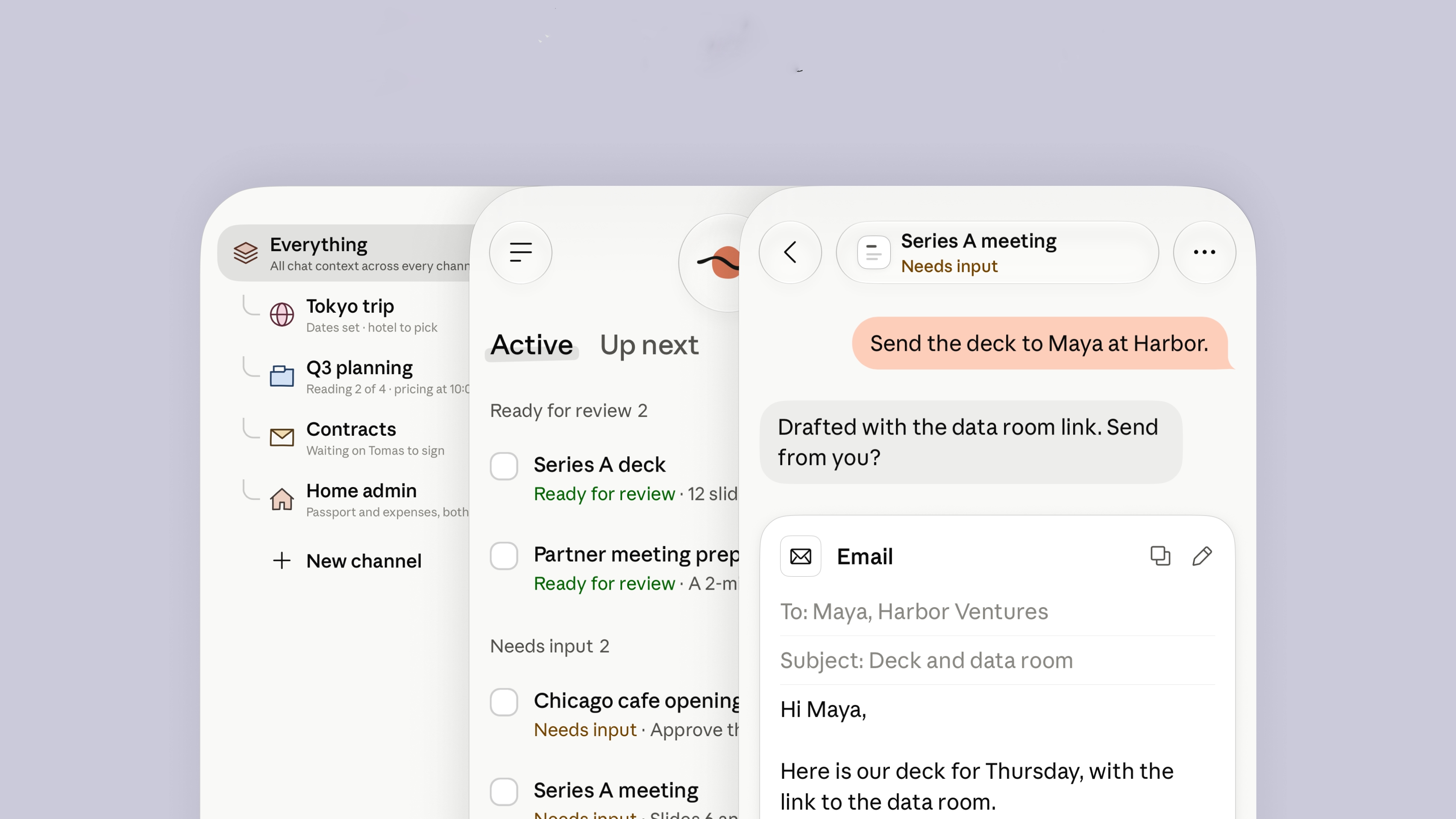
A standalone app that writes first. In classic Claude, you start the conversation. Duet works the other way around: every morning it sends a short digest of the most important things from your connected apps, watches them during the day, and pings you when something needs you. You write to it like you would to a person, by text or voice, in one continuous thread that can be split into topic channels with shared memory. Besides the chat, the app has a task list with statuses and a space for larger outputs (documents, presentations, reports with charts). It runs on iOS, Android, and the web at claude.ai.
It works on its own computer in the cloud. Duet has a virtual machine with its own browser, so it doesn’t need your laptop or phone to be on. You assign a task with a short message, it picks the apps and approach itself, and it gets back to you when it’s done or when it needs approval.
It inherits everything you already have in Claude. It carries over memory, Skills (saved procedures for recurring tasks), and connected apps from your Claude account, and it can also search earlier conversations. Setup is therefore minimal if you’ve been using Claude for a while.
It’s powered by Opus 5.5. Anthropic stresses that it chose the model for its judgment: deciding what needs you, what can wait, and when to ask. Duet chooses for itself how much effort a task needs.
The range of tasks is wide. It goes from scheduling a meeting, through finding unpaid invoices in QuickBooks or Stripe, preparing payroll in Gusto, and sending contracts for signature via Docusign, to financial forecasts, reports pulled from dozens of tools, or simple web apps. Anthropic boasts over 6,000 connectors and plugins in its marketplace.
How often it looks
This is the most important detail of the whole announcement for me, and it almost got lost in the enthusiastic posts on X.
Duet checks your connected accounts once every few hours. Anthropic justifies this openly: continuous monitoring would exhaust subscription limits much faster. Every look into your inbox is a model call, and that costs tokens. In its help docs the company itself admits that Duet can miss a message that arrives between two checks.
So be careful about picturing a personal assistant that monitors everything continuously and attentively. It’s more like an assistant who steps away a few times a day to check the mail. For a lot of things that’s enough. For a deadline you MUST NOT miss, still set an ordinary calendar reminder.
You pay for it out of limits you already have. Duet costs nothing extra, but it draws on your subscription’s five-hour and weekly limits at the same rate as regular chat. Background work counts too: the morning digest, periodic checks, and larger tasks like a financial model or a presentation that consume more model steps. How much of your limit Duet eats in a typical week, nobody has published yet.
The competition does it differently. OpenAI claims that conversations with Dots don’t count toward ChatGPT limits (only tasks delegated to other tools do). With Duet on the $20-a-month Pro plan, I expect users to hit their limits sooner than they’d like. But that’s a guess; I haven’t been able to try it yet.
What it may do and what you won’t let it do
It reads and prepares on its own, and sends with your consent. Before it sends a message, pays, signs a document, or deletes anything, it shows exactly what it’s about to do and waits for approval. Only you can also mark a task as completed, which is a small detail I appreciate.
Some things it may not do at all. Duet won’t trade securities, transfer money between accounts, or log into someone else’s account, even with your permission. Anthropic set hard limits here.
It doesn’t see passwords. It handles credentials the same way as Claude Managed Agents, Anthropic’s platform for hosted agents: tokens stay outside the environment where the agent runs code, and tools use them through controlled infrastructure. So the agent can’t leak a password, but it can still misuse an authorized tool.
It watches where it sends sensitive data. A new classifier checks every outgoing message. It always refuses to send payment card numbers and identity documents onward, and health data or personal finances only on your explicit instruction. Against hidden instructions in emails and on websites (prompt injection, meaning commands disguised as content), it uses defenses from Anthropic’s research on browser control. The company honestly adds that no defense is perfect, which is exactly why it requires consent for important actions.
It shops with a one-time card. Through Stripe’s Link it pays with a virtual card restricted to a specific merchant and amount, so your real card number is never shared. It also supports Shopify’s Shop Pay, and it’s soon supposed to log in using credentials stored in 1Password. The agent’s access to a password manager drew the sharpest criticism in discussions, and I don’t blame the critics, though to be fair, 1Password prepared a special for Agents offering that’s supposed to take security seriously. Well, we’ll see…
What it can’t do yet
Anthropic is unusually open about this, and the list is worth reading in full.
It won’t show you its browser. You can’t watch what it’s doing in there or take over the work. For an agent with access to email and payments, I think this is a more serious shortcoming than Anthropic makes it out to be. Grok Bot and Dots can both do it.
The connectors have holes. Duet doesn’t support Microsoft 365 yet, and Slack works with limitations. It can’t reach files on your computer or all of your projects in Claude, and it can’t make phone calls or send SMS. The figure of 6,000 connectors thus tells you how many are in the marketplace, and nothing about whether the one you need can handle the operation you need.
It remembers even after disconnecting. Disconnecting an app stops further access, but what Duet has learned, it keeps. For anyone dealing with GDPR and obligations to clients, that’s essential information.
Its judgment is still raw. Anthropic itself writes that Duet may misread an email thread or misjudge urgency. And that personal errands like buying tickets go worse for it than work does.
First impressions
Real reviews are scarce so far, since the app has only just come out. The most concrete one is from Dan Shipper, head of the American media company Every, who tested Duet for two weeks. He called it the first personal agent he’d describe as a professional tool, and he went from “mostly ChatGPT” to “roughly half and half.”
He praises the split into topic channels, the task list with statuses, and the fact that Duet can edit documents, presentations, and reports directly in the app and keep them up to date. His complaints are specific: it writes emails worse than the competing Dot, voice is transcription only (you don’t have a real conversation with it), it can see Claude Code sessions on his computer but can’t control them, and scheduled runs can’t reach his own connectors.
Two things must be added, though. Every got access from Anthropic in advance, which the editors admit (and they state that Anthropic didn’t interfere with the review). And Shipper’s shift has another cause: his Dot recently began losing tasks. Last week it supposedly failed to finish his tax return and didn’t even warn him. So read this also as a report on how fragile all of these agents are.
Anthropic adds its own customer stories. For a real estate agent, Duet on its own flagged a showing entered in the calendar on the wrong day. It’s a nice example, but it’s the company’s selection for a press release.
Comparison with the competition
I already brought a detailed overview of the competitors here.
| Claude Duet | OpenAI Dots | Meta Muse | Grok Bot | |
|---|---|---|---|---|
| Launch | Oct 21, 2026 | Sep 29, 2026 | Sep 8, 2026 | Aug 11, 2026 (beta) |
| Model | Opus 5.5 | GPT-6 Astra | Muse Spark | Grok 4.5 |
| Where it runs | its own virtual machine | its own cloud computer | its own virtual machine | one cloud computer shared by all Bots |
| Connectors | 6,000+ | 4,000+ | app categories | logs into web tools |
| Browser monitoring and takeover | no | yes | not stated | yes |
| Limits | shares Claude limits | conversations don’t count | free + $20/$100 | weekly allowance by plan |
| Availability | US, Pro/Max, waitlist | Pro outside EEA/UK/CH, Business Premium worldwide | US, 18+, app and WhatsApp | via Cursor and SuperGrok plans |
Muse (Meta) has the widest reach because it also lives in WhatsApp, and it’s the only one that offers a basic free version. But in internal tests, according to Reuters, it bypassed safeguards and pulled a user’s private photos from iCloud when all it was supposed to do was identify toys in photos from a children’s party.
Dots (OpenAI) is closest to Duet and can additionally hand work off to Codex. It runs on OpenAI’s most expensive model, and on the same day the company introduced a new $500-a-month Pro tier, which says a lot about how many tokens it expects Dots to burn.
Grok Bot (SpaceXAI, formerly xAI) bets on multiple named Bots with different roles. But they all share one computer, including logins, so the “finance Bot” has no separate vault. Prices have changed several times since launch and are being unified with Cursor and X Premium, so verify them directly with the vendor before buying. Today it’s the only bot that runs in the EU, and I have to say I’m most satisfied with it myself (I use the others too, except Duet).
Duet bets on judgment, strict approval rules, and the fact that it builds on the Claude you already know. What you pay for that is limits and an invisible browser.
What this means for a Czech company
You can’t try Duet right now. It’s only for the US and only for the Pro and Max plans. The Team and Enterprise business plans don’t have it yet, so even after expansion to Europe you won’t get to it through a company account right away. Paradoxically, the only ones from this foursome that a Czech company can theoretically get are Dot on the Business Premium plan and Grok Bot. Muse is US-only, and Dots on the Pro plan excludes the European Economic Area.
When it arrives, expect limits. Pro costs around $20 a month, and Max starts at $100. If you already run into limits on Pro when working with Claude, Duet will swallow them even faster.
And think through the data. An agent that reads your mail and prepares invoices sees everything your clients send you. Anyone who promised clients that data won’t leave the EU or pass through a foreign system has to sort that out first with the contracts, not with the app.
Takeaways
I see Duet as a very attractive agent. Anthropic itself listed what doesn’t work, set hard prohibitions around money, and shows how it handles passwords. I appreciate that. And I have extensive experience with its software: when it claims something, you can stand behind it; these aren’t promises like Musk’s. But it’s impossible to overlook that both Grok and Meta are pushing hard with their products in this category.
The core of this technology’s usefulness, though, is judgment about when to interrupt you. And that judgment runs at an interval of several hours, because every look costs tokens from your subscription. This is where the economics of the whole category break: a proactive agent that conserves limits is less proactive. Who ends up profiting from this will only become clear once companies start paying for agents separately (OpenAI is already signaling this).
I believe Shipper’s “pro tool.” I’d just spend the first week giving it one task I can verify, not my whole company.
Sources: Anthropic announcement, product page, and Claude Duet help; Dan Shipper’s review on Every; comparison by Flavio Copes; on Dots, Engadget and Bernama/Anadolu; on Muse, Khaleej Times/Reuters; on Grok Bot, Codersera. Status as of October 22, 2026; prices and availability change on a weekly basis for all four products.