
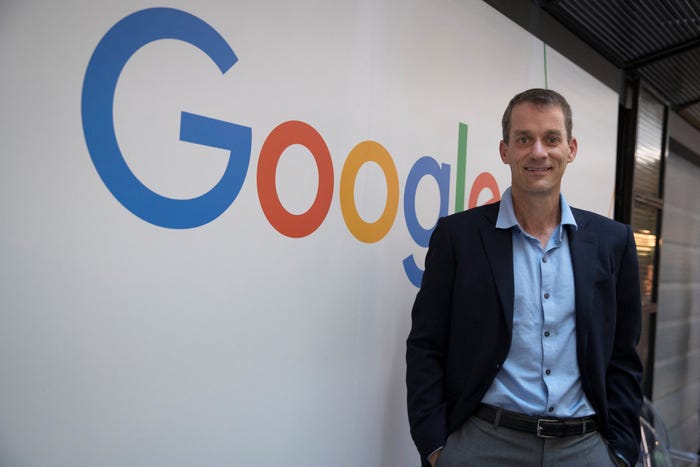
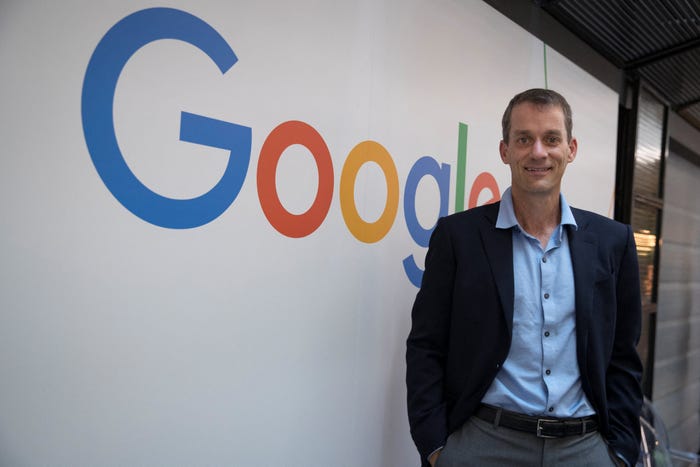
After 27 years, Google’s most senior technical figure is leaving. He is departing with three other stars to found a startup called Discovery Loop, and Alphabet itself chipped in funding and is leasing it compute capacity. The market responded by wiping out roughly $185 billion in value. The story of a departing legend has a second layer, a considerably less romantic one, and it’s worth reading before you start sharing nostalgic memories.
What happened
On August 5, 2026, Google announced that Jeff Dean is leaving after 27 years. According to his own post, his last working day was the following day. He is not leaving alone. He is taking with him Sanjay Ghemawat, one of only two people in the company’s history with the title Senior Fellow, along with Quoc Le, co-founder of Google Brain, and Oriol Vinyals, a vice president at Google DeepMind and co-lead of Gemini development. The four are founding Discovery Loop, a public benefit corporation registered in Delaware, whose goal is to automate the experimental loop of scientific and engineering research. Dean is its CEO, and the company is building a team in Palo Alto and wants everyone physically together.
The funding is led by Radical Ventures and Khosla Ventures. Lightspeed, Kleiner Perkins, Doerr Capital and Alphabet are joining. Google is also supplying compute capacity, with the commitment locked in for at least the first year, and it has also agreed with Discovery Loop on collaboration in machine learning systems research. The company has not disclosed the size of the round or the valuation, and at the time of the announcement the round had not closed.
One piece of context got lost in the first enthusiastic reactions, and it changes the tone of the event somewhat. The announcement did not arrive on its own. The same day, Sundar Pichai sent out a memo titled The next chapter of our AI momentum, in which Demis Hassabis steps back from running Google DeepMind day to day and becomes chairman and, at the same time, Chief Scientist of all of Alphabet. Koray Kavukcuoglu takes over operations as SVP and gets Gemini model development, frontier research and the Gemini app under him. This was a coordinated rebuild of the top of the entire AI organization, and Dean’s departure was wrapped into it. The fact that Dean’s Chief Scientist role was filled by Hassabis that same day, just one floor up at the Alphabet level, is a detail that never made it into the headlines.
It is also worth noting whom Pichai’s memo names. It talks about Dean and Ghemawat. Vinyals and Le, the DeepMind VP and the Google Brain co-founder, do not appear in it at all. So of the four people leaving, official communication deals with half.
The market reacted unambiguously. Alphabet shares that day lost four to five percent, which is roughly $175 to $190 billion in market value, depending on which moment of the trading day you pick. That is about as much as Alphabet plans to spend on data centers over the whole of 2026. And investors were reading a memo in which Pichai boasted about the Gemini app with more than 950 million monthly users and 900 million downloads of Gemma models. The departure of four people outweighed that.
Why it’s such a big name
Dean joined Google in mid-1999 as employee number 30. The company was then based above a shop in Palo Alto, where a T-Mobile store is today. How many people were there, Dean himself says a little differently each time: in his farewell post on X he talks about twenty-five, in a June 2026 speech at the University of Washington about twenty. He is leaving a company with 190,000 employees. He is 58 years old.
The road there began much earlier. As a teenager he took part in developing Epi Info, a tool for epidemiological data analysis that the US CDC still uses today and that was translated into thirteen languages. His parents worked in public health, which explains how he got involved in the first place. He wrote his undergraduate thesis at the University of Minnesota in 1990 on neural networks in C. He earned his PhD at the University of Washington in 1996, on optimization of object-oriented languages. Then came work at DEC Western Research Lab, the cradle of plenty of people who went on to shape Silicon Valley.
Adding it up: a man who wrote about neural networks in 1990 and about compilers in 1996 spent the next thirty years precisely at the intersection of the two topics. Résumés this straightforward are not often seen.
The duo that built the foundations of the modern internet
The best description of Dean’s work is still James Somers’s 2018 New Yorker piece titled The Friendship That Made Google Huge. It describes the partnership of Dean and Ghemawat, who for years programmed together at a single computer. Not in the same office. At one computer.
From the standpoint of today’s infrastructure, that collaboration has a few moments worth recalling.
The year 2000, the index crisis. Google’s search index started returning corrupted data, and words that had no business being there were showing up among the results. The pair converted the index to binary form, tracked down the errors at the memory level and fixed the system. Work weeks back then ran to ninety hours. It was a moment when young Google could have failed technically, and hardly anyone outside would have noticed.
The year 2001, the in-memory index. The discovery that the entire search index fits into RAM across a cluster of cheap machines sped up search by an order of magnitude. And above all, it was an architectural pattern that then repeated practically everywhere.
The years 2004 to 2012: MapReduce, Bigtable, Spanner. A trio of published papers on which half of the modern data world stands. MapReduce gave rise to Hadoop and with it the whole big data wave. Bigtable stands at the birth of HBase and, indirectly, Cassandra. Spanner showed that a globally distributed database with transactional consistency is feasible, which the academic consensus of the time did not admit. On top of that there is the Google File System, which is signed mainly by Ghemawat.
The point is simple. Amazon, Meta, Netflix and no current cloud platform look the way they do without these papers. And most of them came about because Google needed to run a search engine on cheap hardware that routinely broke.
The second career: AI
In 2011 Dean co-founded Google Brain, reportedly after a conversation with Andrew Ng in a micro-kitchen. Then came the famous work on a neural network that taught itself to recognize cats from YouTube videos without anyone teaching it to.
But the most influential decision of that era was a hardware one. When Dean calculated how many servers Google would need to handle speech recognition for all Android users, the answer was doubling the entire server fleet. Which is an answer you can’t take to Larry Page. The answer was to design a specialized chip, and that is how TPUs came about, which today are talked about as the only real alternative to Nvidia’s dominance. TensorFlow followed, then the Pathways architecture and finally Gemini.
Here I’ll allow myself one correction to the mythology, because it keeps being repeated over and over. The Transformer, the architecture on which practically all large language models stand today, originated at Google Brain in a team that fell under Dean’s organization. The authors of Attention Is All You Need are a team of eight, and Dean is not among them. Leading the organization in which something was created is a merit of a different kind than authorship.
A cult Google cultivated itself
On April Fools’ Day 2007, Googler Kenton Varda and an anonymous colleague built an internal website where employees could submit and rate made-up “facts” about Jeff Dean, in the style of the then-popular Chuck Norris Facts. By Varda’s own account, he built it on an internal build of an experimental platform codenamed Prometheus, which later became App Engine. He sent out a fake company email about it. The company went at it with gusto.
Dozens of entries emerged, and they circulate to this day:
Compilers don’t warn Jeff Dean. Jeff Dean warns compilers.
Jeff Dean writes directly in binary. He then writes the source code as documentation for others.
When Jeff Dean has insomnia, he MapReduces sheep.
Jeff Dean’s PIN is the last four digits of pi.
After his departure, lists have started circulating on social media again, with some entries marked as true. They aren’t. Labeling a joke as a verified fact is part of the joke, but after nineteen years of recycling, plenty of people take it seriously. So, for the record:
| Circulating claim | How it really is |
|---|---|
| In 2002, after an outage of the index servers, he answered users’ queries by hand for two hours and quality went up by 5 points | A joke from the April Fools’ site |
| He was promoted to level 11 in a system with a maximum of 10 | A joke. The real basis: for years Dean and Ghemawat were the only two Senior Fellows at Google, the highest technical rank, and internal humor called it level 11 |
| Google Search was his first-week project | A joke |
| Donald Knuth sat on the floor at his Stanford seminar | True, the hall was packed |
| He tracked down the author of the anonymous Jeff Dean Facts site himself | True, see below |
That last entry is better than any made-up fact. When Dean found out about the anonymous site, he didn’t go to the IT department and didn’t use admin privileges. For an hour or two he went through the status pages of internal systems and server logs until he tracked Varda down. Many years later, Varda confirmed it publicly on Hacker News.
Discovery Loop: what we know and what we don’t
The declared goal of the new venture is to automate the whole scientific loop, that is, formulating a hypothesis, running an experiment and evaluating the result, and to run thousands of them in parallel. Dean argues that in many fields this loop can be fully computerized. Ghemawat adds that they wanted to build infrastructure with different requirements from those Google has for its consumer and advertising products.
The first field the company will dive into is research on machine learning itself. Discovery Loop will thus be its own first customer: AI that designs experiments leading to better AI. Only then are hardware design, drug development and energy supposed to follow.
And this is where I switch from admiration to skepticism, because otherwise this would be a PR piece.
Let’s start with the overlap. Recursive self-improvement of models is exactly what Google DeepMind is chasing. The claim that Discovery Loop doesn’t compete with Google because it doesn’t make consumer chatbots sidesteps the heart of the matter. The first product aims at the same problem the parent organization, which the four have just left, is working on. Either the overlap is smaller than it looks from the outside, in which case it would be fair to explain why, or Google is willing to finance a competitor in its own most sensitive area.
Then there is the structure of the investment. Alphabet holds a minority stake in a company it doesn’t control, sells it compute capacity with a one-year commitment, and has arranged a research collaboration. That is not nothing, but it is all time-limited and without control. After the one-year commitment expires, Discovery Loop can solicit capacity anywhere, and every data center operator and chip maker will fight over that account. If the company succeeds in what it declares, the seed stake may look in retrospect like a very cheaply bought bet. I should note that without a disclosed round size this is speculation, not a calculation.
That leaves the question of what is actually being sold. Discovery Loop has no product, no revenue and has not disclosed a valuation. The only asset that exists at this moment is the résumés of four people. The company’s presentation says so openly: three of the most-cited researchers in AI and two of the most-cited in distributed systems. A remarkable lineup, no doubt about that. At the same time, it is exactly the type of offering for which the last three years have shown how large a gulf lies between a star founding lineup and a working product. Investors in Safe Superintelligence and similar ventures are still waiting on that.
And finally, the mythology of Dean himself. The legend describes him as a lone genius, while his own statements from previous years point the opposite way. He has repeatedly stressed that his results came about through teamwork. The strongest argument for Discovery Loop is thus, paradoxically, that Dean is leaving with Ghemawat. A pair that programmed together at one desk for a quarter of a century has a demonstrable ability to get things into production. That is a different quality than a name on paper.
Verdict
Jeff Dean’s departure is the end of an era in the literal sense of the word. A man who stood at the birth of the infrastructure powering the modern internet and then at the birth of the hardware and software powering the current AI wave is leaving the only company he has known since 1999. The cult that grew around him was a joke, but it rested on real achievement. Such a combination is rare in this industry.
The second layer of the story is more sober. Google kept a financial option on wherever its legends went, wrapped the departure into a broader reorganization of leadership and described the parting as amicable. The market nonetheless knocked off $185 billion, which suggests it didn’t fully buy that interpretation.
Whether Discovery Loop will really automate scientific discovery will become clear in a few years, and I wouldn’t bet on it any more than I’m willing to lose. What holds already: the best engineering team of its generation has left the company with the most compute capacity in the world in order to rent that capacity from it. Worth watching.
Sources
- Google: The next chapter of our AI momentum, memo from Sundar Pichai and Demis Hassabis (Aug. 5, 2026)
- Discovery Loop: official website
- Jeff Dean: announcement on X
- Radical Ventures: Our Investment in Discovery Loop
- Wilson Sonsini: Advises Discovery Loop on Launch and Initial Funding (Aug. 5, 2026)
- Quartz: Jeff Dean leaving Google after 27 years to co-found Discovery Loop
- GeekWire: The startup idea that convinced a UW computer science legend to leave Google
- Unite.AI: Jeff Dean Leaves Google to Automate the Scientific Method With Discovery Loop
- Motley Fool: Four of Google’s Top AI Researchers Just Left to Start One Company
- Business Model Analyst: Jeff Dean’s Exit Cost Alphabet $190 Billion
- Slate (2013): Jeff Dean facts: How a Google programmer became the Chuck Norris of the Internet
- Hacker News: Kenton Varda’s comment on the origin of Jeff Dean Facts
- GitHub: TheJeffDeanFacts
- Wikipedia: Jeff Dean
- The New Yorker (2018), James Somers: The Friendship That Made Google Huge