
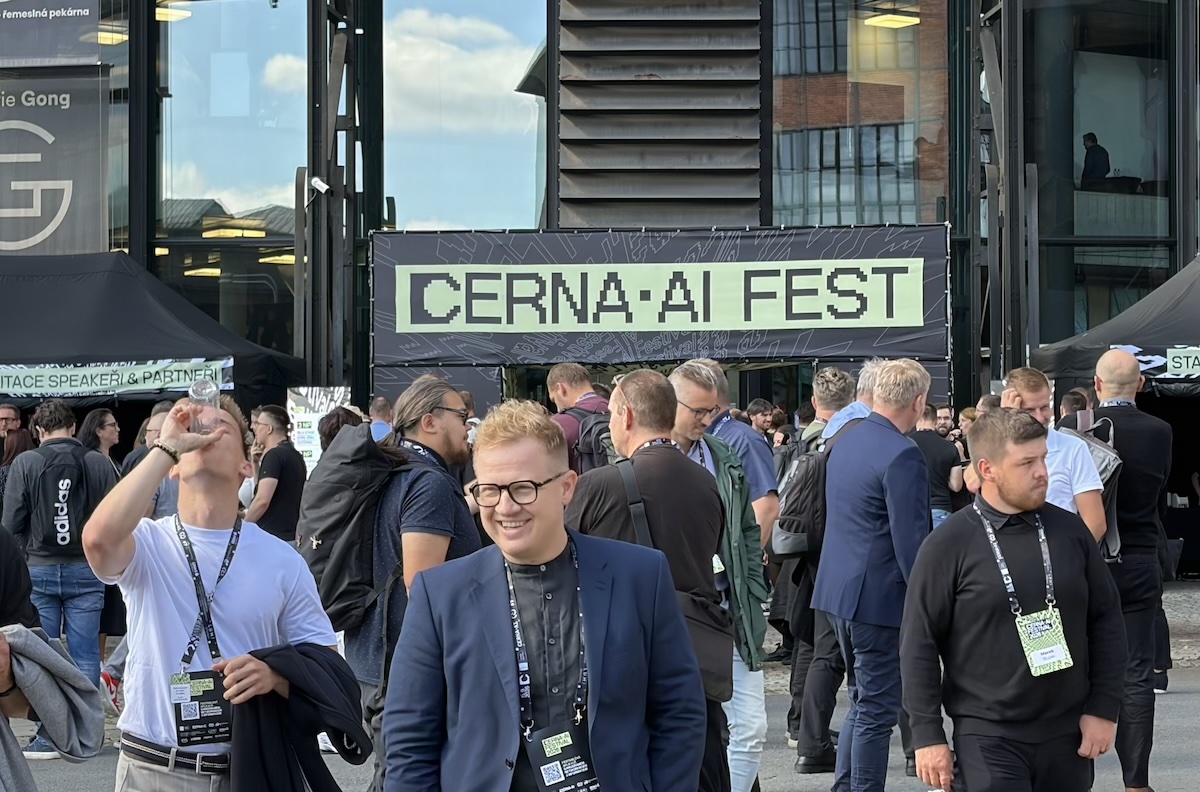
Yesterday I spoke at the Černá AI Festival in Ostrava. Hats off: this event surpassed anything I’ve seen in Czechia. It was beautifully conceived, both visually and in how the program was staged, and it took place in an attractive setting: the former Vítkovice ironworks, now the Dolní Vítkovice park, which also hosts the Colours of Ostrava music festival. If there’s anything we in Prague can envy, it’s definitely these two events.
Černá AI Festival reported 2,200 tickets sold (and sold out quickly), a hundred speakers and 7 stages. At first I had trouble finding the right stage. There was no orientation map in the building (there was one on the website, though). I only found out at the very end that there’s a white stage at the very top, so I hope I didn’t miss too many talks. There were crowds everywhere. The Gong hall isn’t ideal for this, because the staircases and corridors are narrow, but it didn’t matter much, and at least the place looked full. Substantially more people wouldn’t have fit, though. Even the catering ran into queues because of it, which we soon renamed “networking queues.”

My talk was called Harness, Not the Model, Decides, and I talked about what I’ve learned from agentic development and how to manage a harness. I have no idea how people took it, because the speakers before and after me were considerably less technical and more general. I tried to make sure non-developers would take something away too, so I got a laugh when I showed how to detect context overload by requiring the agent to address you as “Grand Vizier.” Or when I looked at a slide and declared that I had no idea what I’d meant by it, so let’s move on to the next one. In reality, the Grand Vizier explanation I’d added for the non-technical audience had eaten the 90 seconds meant for that slide, and I needed to skip it in some funny way, because the time was being strictly watched. I finished at exactly eighteen minutes. So I hope people will now remember what technical debt in AI is and how to work with it using a harness.
If I could wish for something for next year (and I hope there will be a next year!), it would be international participation. A speaker who would show us thinking from elsewhere. I know it’s expensive, but an event like this needs it. My main problem was that ordinary talks bored me (I’d heard this many times before), and the workshops, where you could gain practical experience, were totally overloaded. I have no idea how to solve that organizationally, but the fact is I didn’t get into a single one.
So the most striking speaker for me was the closing one, Jindřich Fáborský. He did a great job commenting on AI slop and FOMO. For exactly this reason I’ve completely backed away from making YouTube videos myself, because I don’t want to make, and don’t know how to make, videos of the “If you can’t do XY, you’re finished” type. And it amused me that Jindřich arrived at the same numbers I did. For example, Hypata has stopped ingesting LinkedIn messages, because statistically 99% was slop without value (T. Čupr and a few other people from the company are the occasional exception that gets through, but those are scraps). And Hypata concludes, just like Jindra Fáborský, that no video material on YouTube delivers a replicable, monetizable workflow.

AI is still waiting for its fundamental tools to be found. Building a “Second Brain” by following a YouTube tutorial is nothing like that. There’s no money in it. Uploading a brand skill to a server so your agents generate PDFs roughly in your company’s brand colors is an incremental improvement, not a revolution, not a second brain. For a second brain you first of all need a first brain, and could I please see that before we start discussing whether to use Hermes or Buzz?
I also make money from training and from helping software companies with the transition: companies that already have their product and just need to align with the AI trend. The few tools we deliver into projects for reasonable money don’t even have a product page. That’s why I like my own projects such as 3gpp-explorer or Přijímačky na školu (a prep tool for school entrance exams). They’re public, and you can demonstrate all sorts of things on them. With Orchestrai that’s not possible. But when Vojtěch Roček asked the audience in one debate what product the panelists would offer for investment, I felt like raising my hand and offering this: a product that precisely breaks a large project into phases and determines where it will get stuck. For example, where the construction of a nuclear power plant, a highway ring road or a data center will stall. But then I let it go. You can’t make any hype out of that.
See you in Ostrava next year. Next time Hypata will help you choose speakers by quality: if all the talks really get published, it will ingest every speaker, rate them and tell you who speaks well and has something to say.
Hats off to the organizers for their ability to pull this event off. By rough estimate (as they say in Ostrava), it must have cost around CZK 5 million, and not everyone can afford to organize that. Together with other activities, it makes Ostrava a leading Czech AI city.
How to do it on the cheap, you’ll see on Tuesday. Come to our Vibecoding Talks at Dlabačov (a venue in Prague)